Feedback & the Open Baryon Cycle
How energetic outflows from black holes and supernovae push gas out of galaxies and haloes — and where that gas ends up (Spoiler: Closure Radius).
Theory, computation, and observation — understanding galaxy formation, large-scale structure, and the physical processes that shape our Universe.
My work is at the intersection of galaxy formation and large-scale structure cosmology, and includes four key branches of research.
How energetic outflows from black holes and supernovae push gas out of galaxies and haloes — and where that gas ends up (Spoiler: Closure Radius).
How galaxies falling into groups and clusters, or moving through other cosmic web structures (e.g. filaments), lose their gas and stop forming stars.
Developing compelx galaxy formation models using multiple techniques: hydrodynamical simulations and semi-analytic models; and testing them against data.
Whether our current understanding of galaxy-formation physics can explain the surprisingly mature galaxies JWST keeps finding (Spoiler: No, not yet).
The open baryon cycle is a key component of my research.
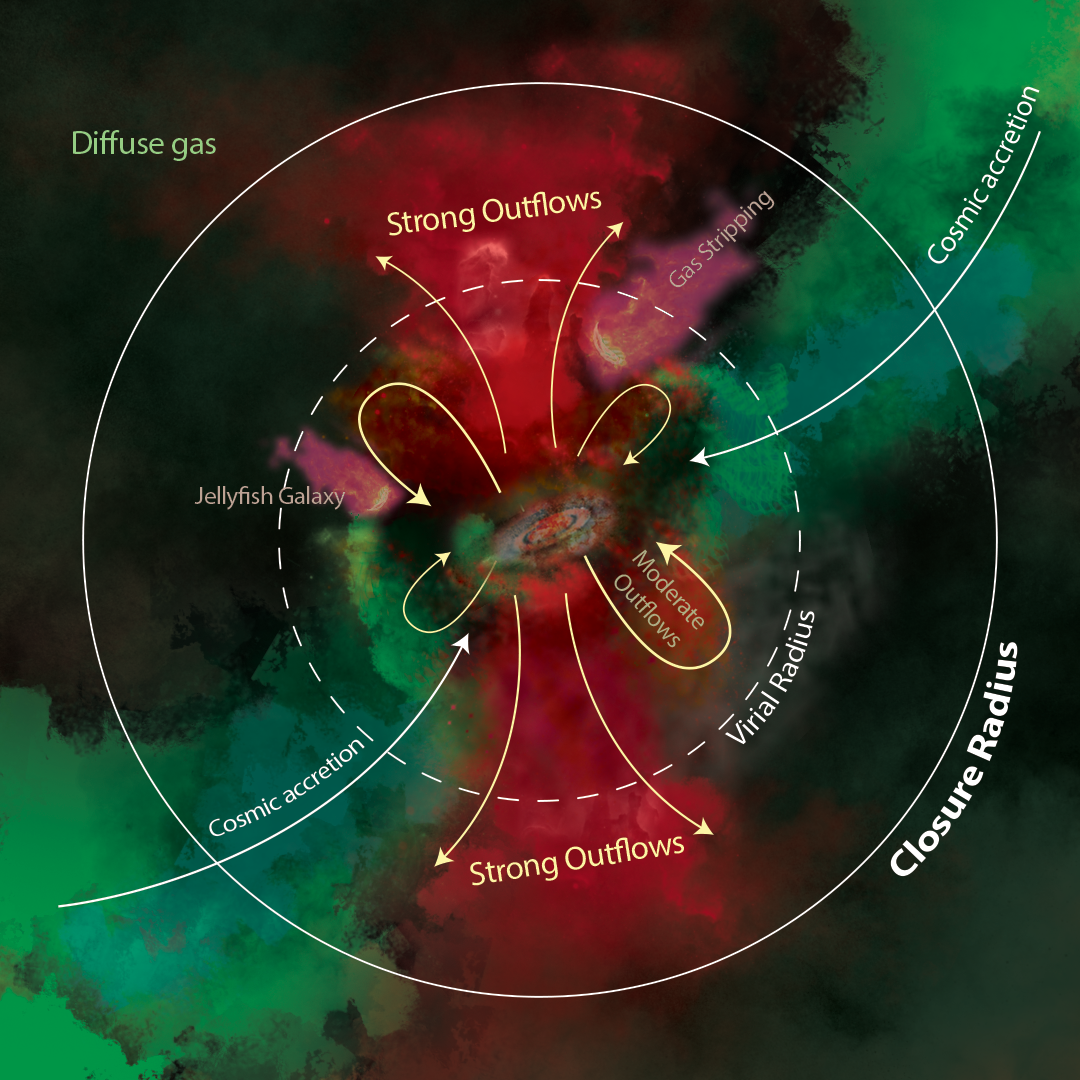
Cosmic accretion feeds the halo, energetic outflows from stars and super massive black holes redistribute the baryons, and the environment strips the gas from galaxies. I measure and model these flows — and what they imprint on the gas, out to the closure radius and beyond that in the intergalactic medium (IGM). Figure from Ayromlou et al. 2026.
Papers, data releases, and public catalogues live on the Publications page.